
Mixing Materials: PLA ↔ PETG ↔ ABS
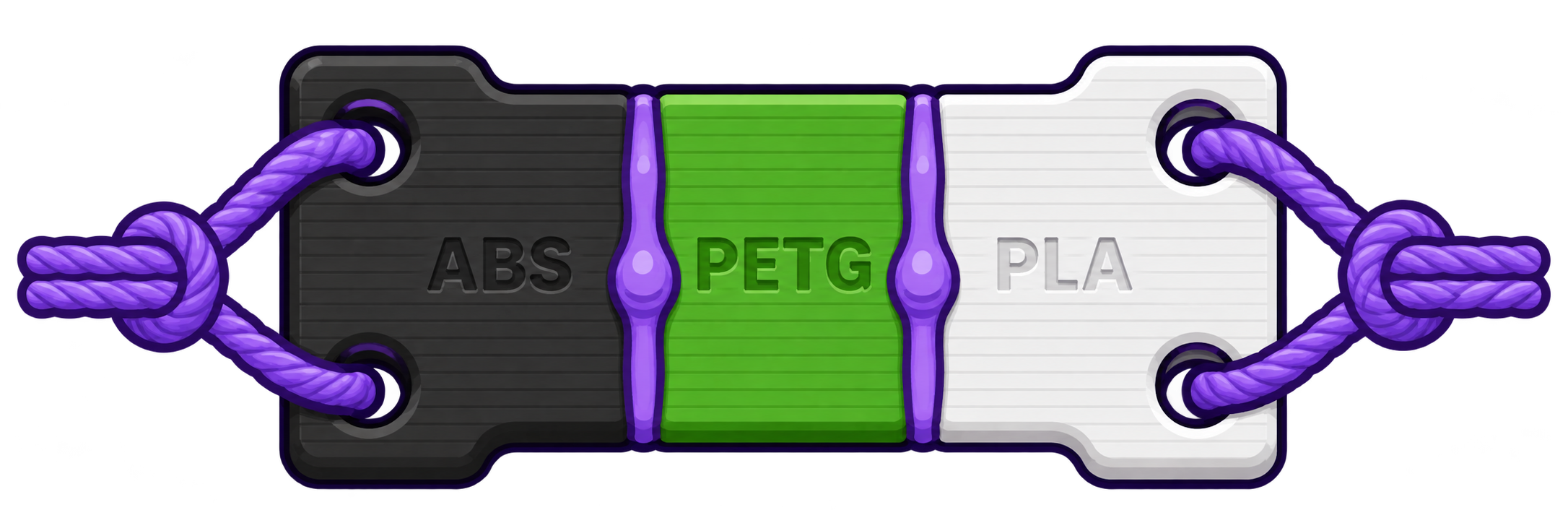
TL;DR: The Respective-Gloop! Rule: put PLA Gloop! on the PLA part, PETG Gloop! on the PETG part, press with a twist. Gloop! bonds to Gloop!, and it bonds quite strong. Don't cross-apply flavors... that's just solvent welding/diffusion bonding in a trench coat. While it may work, it's weaker.
One flavor per polymer: that's the whole trick
Gloop! isn't a universal glue, and that's on purpose: each flavor's solvent package and monomer complex is engineered for its polymer family. So when two different plastics need to become one part, the procedure is delightfully simple:
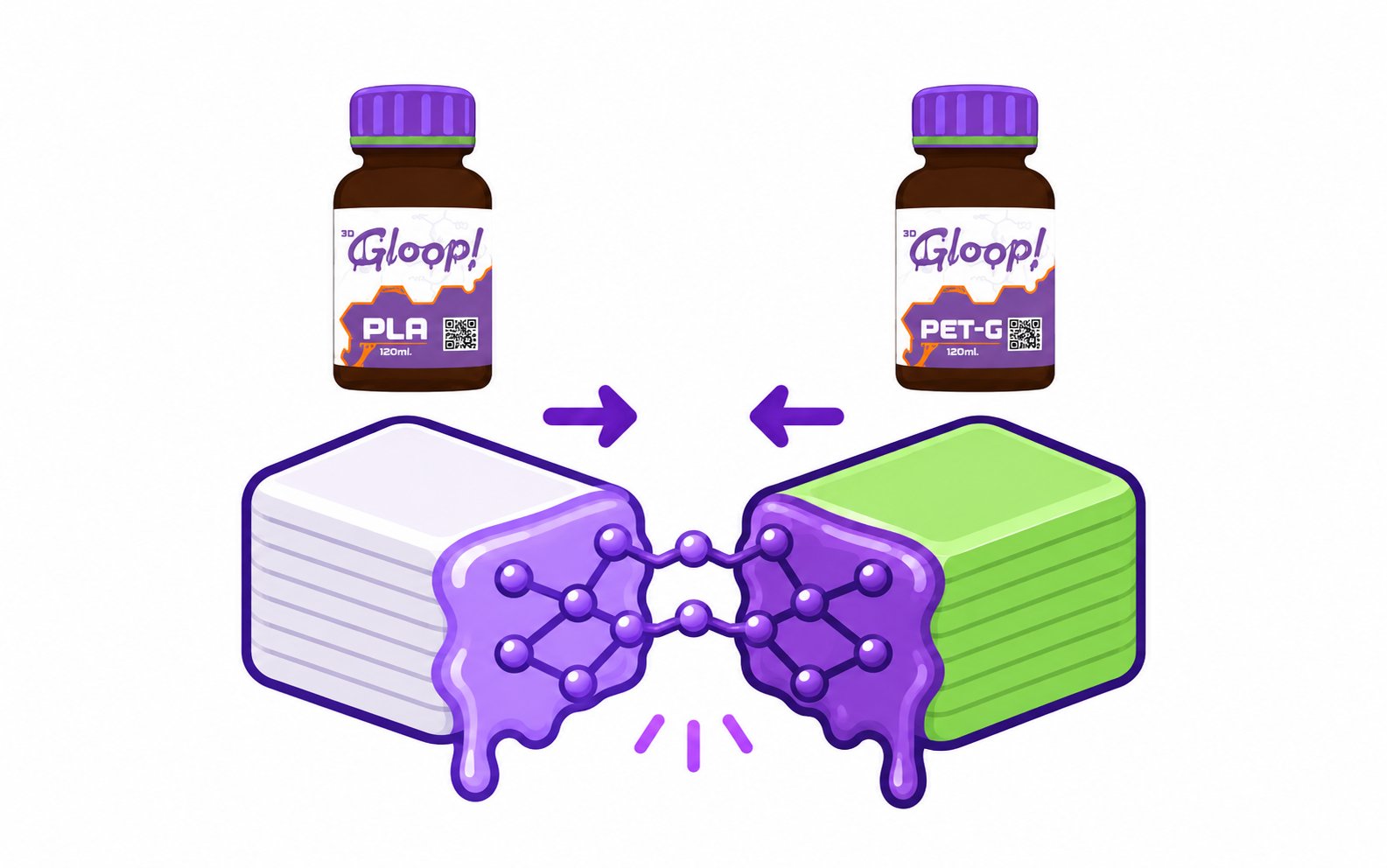
The Respective-Gloop! Rule 1. Slather PLA Gloop! on the PLA part. 2. Slather PETG Gloop! on the PETG part. (Or ABS/ASA Gloop! on the ABS part... you see the pattern.) 3. Apply generously, then press together with a twist while both sides are wet.
Each flavor welds INTO its own plastic, and at the joint line the two cure together: Gloop! bonds to Gloop!, and it bonds quite strong. Same procedure for any pairing: PLA↔PETG, PETG↔ABS, PLA↔ABS.
What about cross-applying? (Don't.)
PLA Gloop! painted onto PETG will sometimes appear to work... but without its matching polymer, none of the crosslinking chemistry engages. You get plain old solvent welding: weaker, less predictable, and definitely not recommended by the Scientists, the Robot Overlords, or the laws of chemistry.
Blends and the "is this even PLA?" question
PLA blends (PLA+, silk, lightweight, PLA-CF…): PLA Gloop! works as long as the base resin is roughly 60–70%+ PLA, which covers nearly everything sold as PLA.
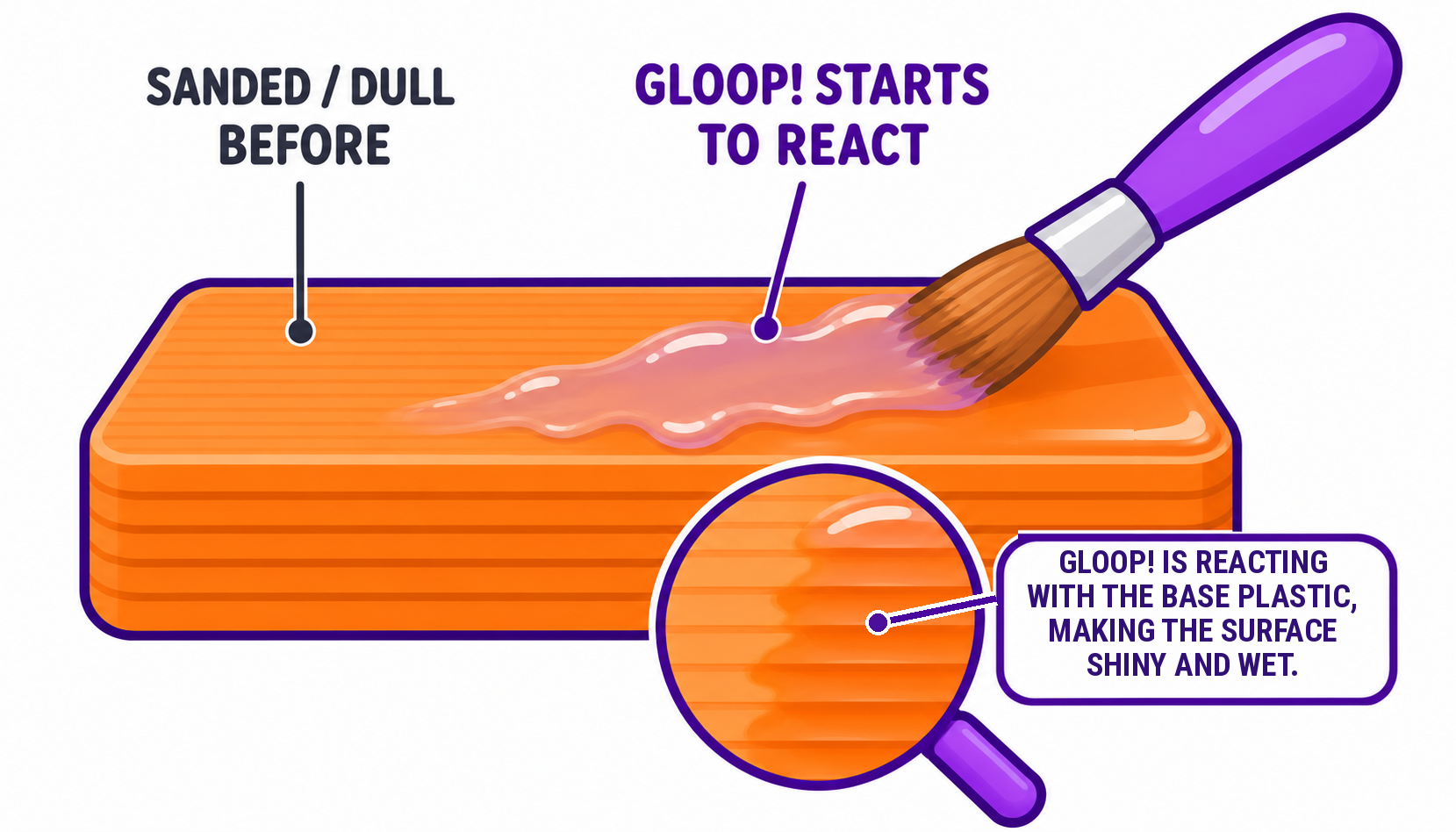
The instant compatibility test: sand the surface dull, then apply Gloop!. If the color and shine come back, the solvent is reacting with your plastic. Green light.
PETG: a heads-up from the chemistry department
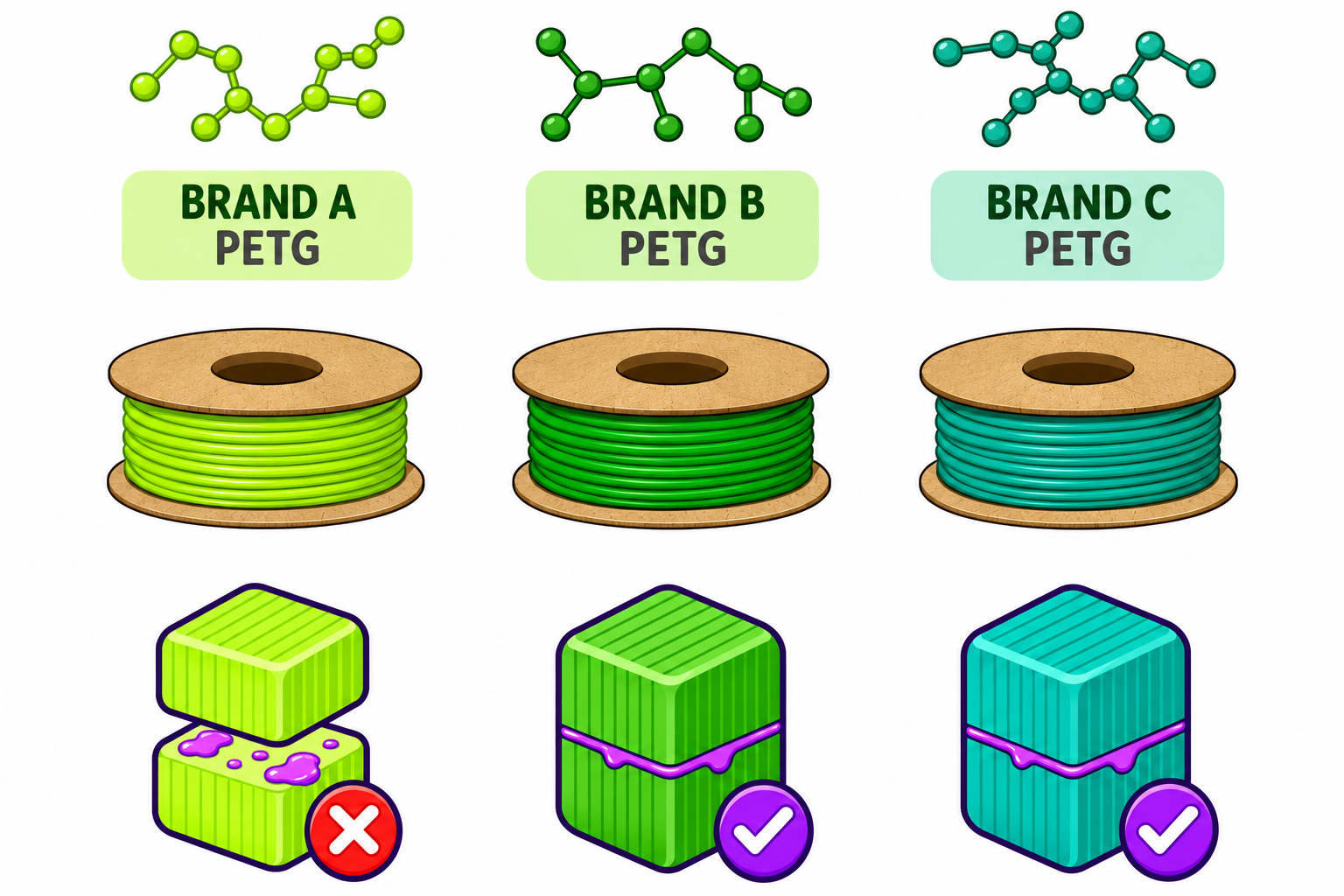
Ever wonder why one brand of PETG behaves differently from another? Most PLA on the market traces back to essentially one supply chain, and PETG doesn't. Every producer's synthesis is a little different, so molecular weights and additive packages vary brand to brand. Translation: most quality PETG welds beautifully, but not every PETG is the same molecule. We strongly recommend printing some sample coupons to try Gloop!'n first. Our PETG is a go/no-go sort of situation: if you get a good bond on your test, it's likely that your actual prints will be successful. If you notice weak bonds, or Gloop! that doesn't seem to cure, then there's no amount of prep work or application technique that will make that bond successful. You will have to change filaments.
Two PETG-specific lab notes:
PETG Gloop! is deliberately thinner than the other flavors (PETG demands a higher solvent load for reactivity). It's not watered down, it's calibrated to work with as many variations of PETG as possible. Just be mindful that runs and drips are common. PPE and proper workspace protection are very important!
Strength hack: after clamping a PETG joint, gently warming it increases final bond strength. (Gently. Hair-dryer warm, not heat-gun apocalypse.)
Next: when bonds go wrong (and how to un-wrong them): Common Mistakes & Fixes →